
Run your business processes 24/7, 365 days a year without fatigue or limits.
Capital Efficiency: Eliminates working capital drag by automating procurement, cash flow forecasting, and receivables.
Margin Expansion: Cuts variable operational expenses by replacing manual administrative workflows with self-executing digital processes.
Velocity: Accelerates execution speed across sales, supply chain, and compliance by removing human bottlenecks.
Risk Mitigation: Prevents compliance failures and operational errors through real-time multi-system auditing and monitoring.
Strategic Focus: Reallocates executive bandwidth from operational firefighting to high-value revenue generation and strategic growth.
Written processes were once limited to oral tradition, then monks and a handful of scribes doing human drudge work of rote copying. Caxton’s movable type brought knowledge to the masses. Literacy followed and a massive growth in capability. The industrial revolution transformed lives making basic products available to all, not just the elite and swept away businesses that were late in changing just as electronics and computers brought massive change the displaced the incumbents. Right now the same revolution is occurring again at accelerated speed on and those who use humans as ‘fleshware’ – thinking machine are rapidly being moved aside once again. Processes that have held back growth are suddenly expanding like compound interest and those who take the drudge work from their workforce and hand it to machines will win this round in very very few years indeed.
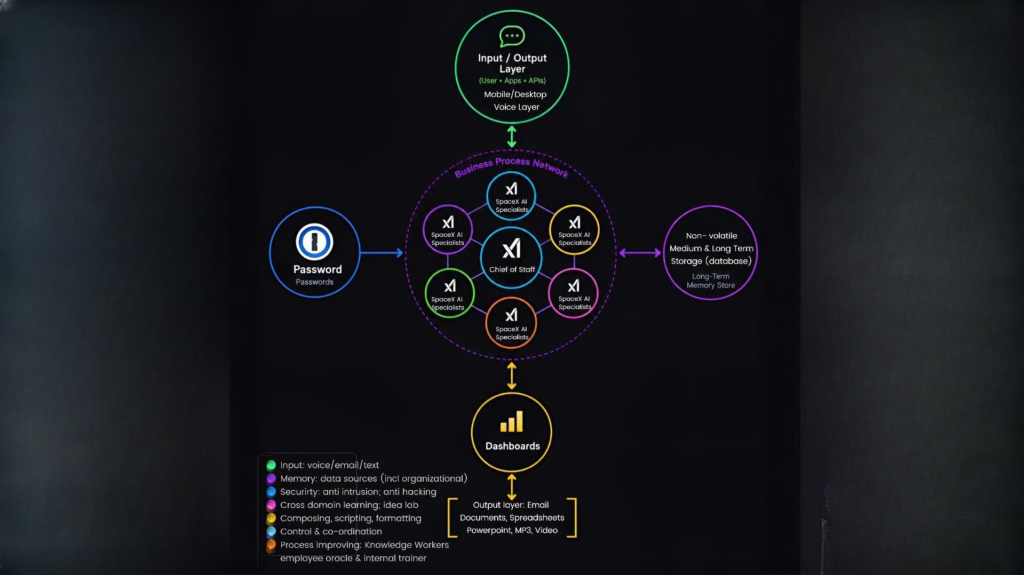
Those who just use AIs as a sort of souped up search engine or to generate documents are in the same position as those early days when a many with a red flag walked in front of every car. In the last few months organizations are being transformed by networks of autonomous “agent” – each using AI to do the job (the drudge work) of a skilled knowledge worker, administrator or keyboard worker 24/7 at super speed. These technologies are not trivially easy to implement – there are very specific techniques to prevent security issues, and ‘hallucinations’ and ensure cross checking and learning from organizational practices.
But that’s what we do – the right stack of technologies, based around exactly the systems that SpaceX uses to build, design and operate spaceships and massive satellite arrays in space – all transferred and trained by us to be at your fingertips (and your voice command) take on your business challenges and take you to the next level.
1. Autonomous End-to-End Procure-to-Pay (P2P) & Working Capital Optimization
- Impact Mechanism: Agents continuously monitor cash conversion cycles, automatically matching purchase orders, receiving logs, and vendor invoices while dynamically capturing early-payment cash discounts or delaying outflows within allowable credit terms to maximize treasury yield.
- Improvements Seen: 85% reduction in invoice processing cycle times; 1.5% to 3% direct margin savings via captured early-payment discounts and avoidance of duplicate/erroneous billing; zero manual data entry for accounts payable.
2. Cross-System Revenue Operations (RevOps) & Autonomous Pipeline Leakage Plug
- Impact Mechanism: Multi-agent networks synthesize CRM interactions, email threads, billing data, and customer success tickets in real time to autonomously flag churn risks, draft targeted executive re-engagement plays, and execute dynamic quote-to-contract generation.
- Improvements Seen: 20% to 35% decrease in customer churn; 40% reduction in sales administration overhead; average sales cycle length shortened by 18 days.
3. Automated Regulatory, Tax, and Multi-Jurisdictional Compliance Auditing
- Impact Mechanism: Autonomous monitoring agents map transactions, cross-border movements, and payroll metrics against changing regional tax codes and compliance mandates (e.g., VAT, corporate tax, cross-border transfer pricing), flagging anomalies and generating audit-ready documentation preemptively.
- Improvements Seen: 90% reduction in compliance preparation hours; near-zero risk of late-filing penalties or unexpected retroactive tax liabilities; substantial reduction in external advisory billable hours.
4. Dynamic Supply Chain Re-Routing & Inventory Buffer Minimization
- Impact Mechanism: Agents monitor live shipping lanes, weather patterns, supplier lead times, and internal ERP inventory thresholds to autonomously re-route shipments or re-order stock ahead of disruptions, keeping working capital tied up in stock to an absolute minimum.
- Improvements Seen: 25% reduction in holding costs; 50% fewer stockout incidents; 30% reduction in expedited freight costs.
5. Automated M&A Due Diligence & Technical/Financial Data Room Ingestion
- Impact Mechanism: For mid-market firms pursuing bolt-on acquisitions, agent networks ingest thousands of pages of unstructured data room documents (legal contracts, cap tables, customer lists, historical financials) to generate forensic risk matrices and valuation models within hours instead of weeks.
- Improvements Seen: 80% reduction in initial due diligence timelines; identification of hidden liability clauses or customer concentration risks that human review frequently misses.
6. Intelligent Customer Success & Tier-0/1 Operational Resolution
- Impact Mechanism: Context-aware support agents resolve complex, multi-system support tickets (e.g., checking order status, issuing refunds via ERP, updating account profiles) autonomously with human-grade contextual intelligence, escalating only edge cases to human specialists.
- Improvements Seen: 70% automated first-contact resolution; 60% decrease in support operational expenditure; support CSAT score increases of 15–20 points due to instant response times.
7. Automated Technical Documentation, Code Maintenance, & Internal Legacy Modernization
- Impact Mechanism: Development-focused agents continuously scan internal codebases or legacy scripts, write comprehensive unit tests, document APIs, refactor technical debt, and translate older database queries into modern architectures.
- Improvements Seen: 3x acceleration in software feature deployment; 50% reduction in system downtime caused by unflagged regressions; elimination of tribal knowledge bottlenecks when engineering staff transition.
8. Dynamic Pricing & Competitor Scraping Intelligence Engine
- Impact Mechanism: Pricing agents continuously ingest competitor pricing shifts, macro cost-of-goods-sold (COGS) fluctuations, and internal inventory velocity to dynamically suggest or autonomously update pricing tiers across e-commerce or B2B contract proposals.
- Improvements Seen: 4% to 8% gross margin expansion on variable product lines; real-time responsiveness to market shifts without manual pricing committee delays.
9. Automated Talent Sourcing, Screening, and Initial Cultural/Technical Fit Assessment
- Impact Mechanism: HR agents ingest open role requirements, cross-reference candidate pools across professional networks, execute multi-turn technical or behavioral screening chats, and compile structured executive-ready candidate dossiers.
- Improvements Seen: 70% reduction in time-to-hire for mid-level technical and operational roles; 80% decrease in recruiter screening hours; higher retention rates via improved upfront skills matching.
10. Automated Treasury Cash Flow Forecasting & Liquidity Management
- Impact Mechanism: Financial agents aggregate daily inflows, outflows, seasonal variances, and macroeconomic indicators to generate rolling 90-day and 12-month cash flow models, automatically recommending optimal debt service schedules or short-term yield placements.
- Improvements Seen: Elimination of cash flow blind spots; optimization of overnight interest yields; prevention of liquidity crunches during seasonal working capital troughs.
11. Automated Grant, R&D Tax Credit, and Subsidy Capture
- Impact Mechanism: Agents continuously audit internal engineering tasks, project logs, and payroll allocations against active government grants, R&D tax relief schemes (e.g., UK R&D tax credits), and regional economic subsidies, automatically compiling compliant claim portfolios.
- Improvements Seen: 100% capture of eligible R&D expenditure credits; 75% reduction in administrative cost required to prepare and file complex government incentive claims.
12. Automated Enterprise Risk Management & Cybersecurity Incident Triage
- Impact Mechanism: Security and IT agents monitor system logs, network traffic, and access permissions in real time, automatically isolating compromised endpoints, drafting incident reports, and executing remediation protocols according to pre-set security frameworks.
- Improvements Seen: 90% reduction in mean-time-to-detect (MTTD) and mean-time-to-respond (MTTR) for security events; continuous compliance readiness for ISO 27001 or SOC 2 audits.
13. Dynamic Marketing Content Personalization & Multi-Channel Campaign Execution
- Impact Mechanism: Content and marketing agents analyze customer buyer journeys to autonomously generate, test, and deploy hyper-personalized email campaigns, ad copy variants, and targeted B2B outreach collateral at scale.
- Improvements Seen: 3x increase in campaign throughput and variant testing velocity; 25% uplift in conversion rates on outbound B2B sequences.
14. Intelligent Contract Lifecycle Management & Automated Renewal Tracking
- Impact Mechanism: Legal and operational agents parse all company master service agreements (MSAs), vendor contracts, and client leases into structured data, tracking renewal dates, price escalation clauses, and compliance obligations while drafting renewal notices automatically.
- Improvements Seen: Zero inadvertent auto-renewals of unfavorable legacy vendor contracts; 100% capture of scheduled contractual price increases across customer accounts.
15. Automated Cap Table, Shareholder Communication, and Board Reporting
- Impact Mechanism: Investor relations agents ingest monthly financial ledgers, operational KPIs, and department updates to autonomously draft comprehensive board decks, shareholder update letters, and cap table scenario models.
- Improvements Seen: 80% reduction in the administrative burden of preparing board materials; faster, data-driven alignment between executive leadership and board members.
16. Automated Production Scheduling & Equipment Maintenance Optimization
- Impact Mechanism: For manufacturing or asset-heavy mid-size firms, IoT-linked agents analyze machinery telemetry data to predict component failures before they occur and dynamically adjust factory production schedules to prevent downtime.
- Improvements Seen: 35% reduction in unscheduled machine downtime; 20% extension in equipment operational lifespan; optimized throughput matching raw material arrivals.
17. Automated Facilities, Real Estate, and Lease Portfolio Optimization
- Impact Mechanism: Real estate and administrative agents track facility utilization metrics, lease expiration timelines, and regional commercial real estate pricing to model consolidation scenarios, remote-work footprints, and workspace cost reductions.
- Improvements Seen: 15% to 25% reduction in total facility footprint costs; proactive renegotiation windows secured 12 months prior to lease maturities.
18. Automated Employee Onboarding & Cross-System Provisioning
- Impact Mechanism: HR and IT agents orchestrate the entire new-hire journey—generating employment agreements, provisioning workspace accounts (email, Slack, ERP, CRM) with least-privilege security roles, and scheduling baseline compliance training.
- Improvements Seen: New-hire time-to-productivity reduced from weeks to days; 100% elimination of orphaned IT accounts and security access gaps post-departure.
19. Automated Vendor Performance Scoring & RFQ Management
- Impact Mechanism: Procurement agents track supplier delivery accuracy, quality defect rates, and pricing consistency, automatically issuing Requests for Quotation (RFQs) to alternative vetted suppliers when performance metrics dip below thresholds.
- Improvements Seen: Continuous downward pressure on vendor pricing; systematic elimination of underperforming supply chain partners without manual oversight.
20. Automated Internal Knowledge Management & Tribal Intelligence Retrieval
- Impact Mechanism: Enterprise-wide vector search and synthesis agents ingest unstructured internal documentation, Slack histories, meeting recordings, and SOPs, serving as an instant institutional memory engine for employees.
- Improvements Seen: 40% reduction in time wasted by staff searching for internal answers or replicating previously solved problems; preservation of institutional knowledge during employee turnover.
St Mark SI
St Mark SI is a UK company with an award winning management team with over 35 combined years of cutting edge AI experience. It is a a trading name of Lake Geneva Holdings Limited, Private UK company No. 12854565 incorporated in England & Wales at 128 City Road, London, EC1V 2NX,